Hint
For a deeper understanding, we recommend reading our article on the CNCF blog post titled "Recommended Architectures for PostgreSQL in Kubernetes", which provides valuable insights into best practices and design considerations for PostgreSQL deployments in Kubernetes.
This documentation page provides an overview of the key architectural considerations for implementing a robust business continuity strategy when deploying PostgreSQL in Kubernetes. These considerations include:
- Deployments in stretched vs. non-stretched clusters: Evaluating the differences between deploying in stretched clusters (across 3 or more availability zones) versus non-stretched clusters (within a single availability zone).
- Reservation of
postgresworker nodes: Isolating PostgreSQL workloads by dedicating specific worker nodes topostgrestasks, ensuring optimal performance and minimizing interference from other workloads. - PostgreSQL architectures within a single Kubernetes cluster: Designing effective PostgreSQL deployments within a single Kubernetes cluster to meet high availability and performance requirements.
- PostgreSQL architectures across Kubernetes clusters for disaster recovery: Planning and implementing PostgreSQL architectures that span multiple Kubernetes clusters to provide comprehensive disaster recovery capabilities.
Synchronizing the state
PostgreSQL is a database management system and, as such, it needs to be treated as a stateful workload in Kubernetes. While stateless applications mainly use traffic redirection to achieve High Availability (HA) and Disaster Recovery (DR), in the case of a database, state must be replicated in multiple locations, preferably in a continuous and instantaneous way, by adopting either of the following two strategies:
- storage-level replication, normally persistent volumes
- application-level replication, in this specific case PostgreSQL
EDB Postgres® AI for CloudNativePG™ Cluster relies on application-level replication, for a simple reason: the PostgreSQL database management system comes with robust and reliable built-in physical replication capabilities based on Write Ahead Log (WAL) shipping, which have been used in production by millions of users all over the world for over a decade.
PostgreSQL supports both asynchronous and synchronous streaming replication over the network, as well as asynchronous file-based log shipping (normally used as a fallback option, for example, to store WAL files in an object store). Replicas are usually called standby servers and can also be used for read-only workloads, thanks to the Hot Standby feature.
Important
We recommend against storage-level replication with PostgreSQL, although EDB Postgres® AI for CloudNativePG™ Cluster allows you to adopt that strategy. For more information, please refer to the talk given by Chris Milsted and Gabriele Bartolini at KubeCon NA 2022 entitled "Data On Kubernetes, Deploying And Running PostgreSQL And Patterns For Databases In a Kubernetes Cluster" where this topic was covered in detail.
Kubernetes architecture
Kubernetes natively provides the possibility to span separate physical locations - also known as data centers, failure zones, or more frequently availability zones - connected to each other via redundant, low-latency, private network connectivity.
Being a distributed system, the recommended minimum number of availability zones for a Kubernetes cluster is three (3), in order to make the control plane resilient to the failure of a single zone. For details, please refer to "Running in multiple zones". This means that each data center is active at any time and can run workloads simultaneously.
Note
Most of the public Cloud Providers' managed Kubernetes services already provide 3 or more availability zones in each region.
Multi-availability zone Kubernetes clusters
The multi-availability zone Kubernetes architecture with three (3) or more zones is the one that we recommend for PostgreSQL usage. This scenario is typical of Kubernetes services managed by Cloud Providers.
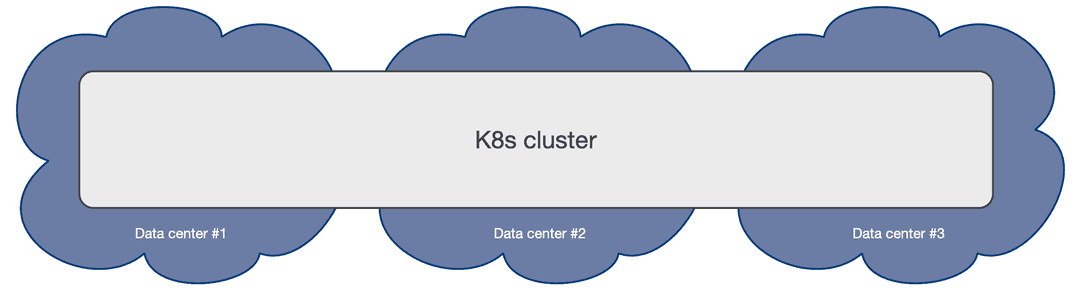
Such an architecture enables the EDB Postgres® AI for CloudNativePG™ Cluster operator to control the full
lifecycle of a Cluster resource across the zones within a single Kubernetes
cluster, by treating all the availability zones as active: this includes, among
other operations,
scheduling the workloads in a declarative manner (based on
affinity rules, tolerations and node selectors), automated failover,
self-healing, and updates. All will work seamlessly across the zones in a single
Kubernetes cluster.
Please refer to the "PostgreSQL architecture" section below for details on how you can design your PostgreSQL clusters within the same Kubernetes cluster through shared-nothing deployments at the storage, worker node, and availability zone levels.
Additionally, you can leverage Kubernetes clusters to deploy distributed PostgreSQL topologies hosting "passive" PostgreSQL replica clusters in different regions and managing them via declarative configuration. This setup is ideal for disaster recovery (DR), read-only operations, or cross-region availability.
Important
Each operator deployment can only manage operations within its local Kubernetes cluster. For operations across Kubernetes clusters, such as controlled switchover or unexpected failover, coordination must be handled manually (through GitOps, for example) or by using a higher-level cluster management tool.
Single availability zone Kubernetes clusters
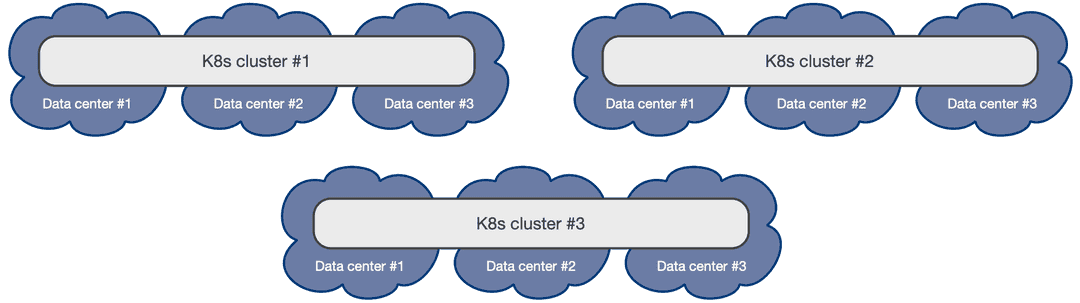
If your Kubernetes cluster has only one availability zone, EDB Postgres® AI for CloudNativePG™ Cluster still provides you with a lot of features to improve HA and DR outcomes for your PostgreSQL databases, pushing the single point of failure (SPoF) to the level of the zone as much as possible - i.e. the zone must have an outage before your EDB Postgres® AI for CloudNativePG™ Cluster clusters suffer a failure.
This scenario is typical of self-managed on-premise Kubernetes clusters, where only one data center is available.
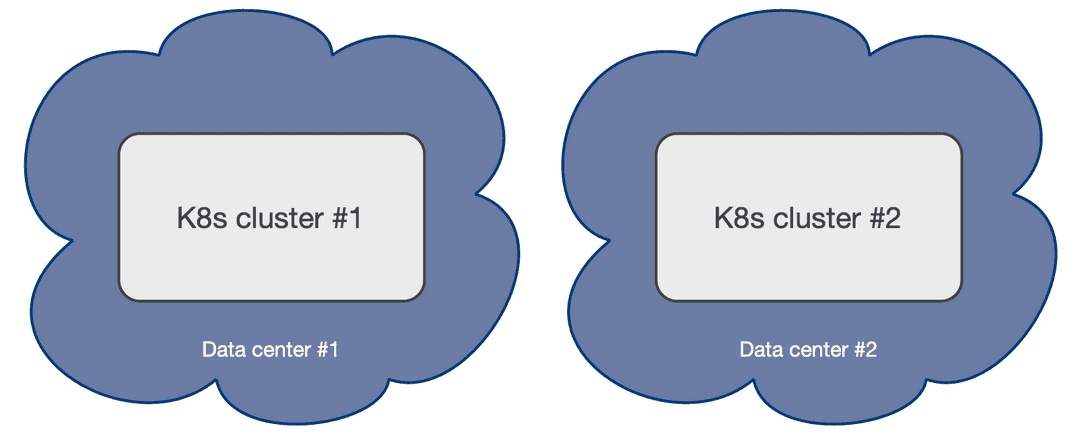
Single availability zone Kubernetes clusters are the only viable option when only two data centers are available within reach of a low-latency connection (typically in the same metropolitan area). Having only two zones prevents the creation of a multi-availability zone Kubernetes cluster, which requires a minimum of three zones. As a result, users must create two separate Kubernetes clusters in an active/passive configuration, with the second cluster primarily used for Disaster Recovery (see the replica cluster feature).
Hint
If you are at an early stage of your Kubernetes journey, please share this document with your infrastructure team. The two data centers setup might be simply the result of a "lift-and-shift" transition to Kubernetes from a traditional bare-metal or VM based infrastructure, and the benefits that Kubernetes offers in a 3+ zone scenario might not have been known, or addressed at the time the infrastructure architecture was designed. Ultimately, a third physical location connected to the other two might represent a valid option to consider for organization, as it reduces the overall costs of the infrastructure by moving the day-to-day complexity from the application level down to the physical infrastructure level.
Please refer to the "PostgreSQL architecture" section below for details on how you can design your PostgreSQL clusters within your single availability zone Kubernetes cluster through shared-nothing deployments at the storage and worker node levels only. For HA, in such a scenario it becomes even more important that the PostgreSQL instances be located on different worker nodes and do not share the same storage.
For DR, you can push the SPoF above the single zone, by using additional Kubernetes clusters to define a distributed topology hosting "passive" PostgreSQL replica clusters. As with other Kubernetes workloads in this scenario, promotion of a Kubernetes cluster as primary must be done manually.
Through the replica cluster feature, you can define a distributed PostgreSQL topology and coordinate a controlled switchover between data centers by first demoting the primary cluster and then promoting the replica cluster, without the need to re-clone the former primary. While failover is now fully declarative, automated failover across Kubernetes clusters is not within EDB Postgres® AI for CloudNativePG™ Cluster' scope, as the operator can only function within a single Kubernetes cluster.
Important
EDB Postgres® AI for CloudNativePG™ Cluster provides all the necessary primitives and probes to coordinate PostgreSQL active/passive topologies across different Kubernetes clusters through a higher-level operator or management tool.
Reserving nodes for PostgreSQL workloads
Whether you're operating in a multi-availability zone environment or, more
critically, within a single availability zone, we strongly recommend isolating
PostgreSQL workloads by dedicating specific worker nodes exclusively to
postgres in production. A Kubernetes worker node dedicated to running
PostgreSQL workloads is referred to as a Postgres node or postgres node.
This approach ensures optimal performance and resource allocation for your
database operations.
Hint
As a general rule of thumb, deploy Postgres nodes in multiples of three—ideally with one node per availability zone. Three nodes is an optimal number because it ensures that a PostgreSQL cluster with three instances (one primary and two standby replicas) is distributed across different nodes, enhancing fault tolerance and availability.
In Kubernetes, this can be achieved using node labels and taints in a
declarative manner, aligning with Infrastructure as Code (IaC) practices:
labels ensure that a node is capable of running postgres workloads, while
taints help prevent any non-postgres workloads from being scheduled on that
node.
Important
This methodology is the most straightforward way to ensure that PostgreSQL
workloads are isolated from other workloads in terms of both computing
resources and, when using locally attached disks, storage. While different
PostgreSQL clusters may share the same node, you can take this a step further
by using labels and taints to ensure that a node is dedicated to a single
instance of a specific Cluster.
Proposed node label
EDB Postgres® AI for CloudNativePG™ Cluster recommends using the node-role.kubernetes.io/postgres label.
Since this is a reserved label (*.kubernetes.io), it can only be applied
after a worker node is created.
To assign the postgres label to a node, use the following command:
kubectl label node <NODE-NAME> node-role.kubernetes.io/postgres=
To ensure that a Cluster resource is scheduled on a postgres node, you must
correctly configure the .spec.affinity.nodeSelector stanza in your manifests.
Here’s an example:
spec:
  # <snip>
  affinity:
    # <snip>
    nodeSelector:
      node-role.kubernetes.io/postgres: ""
Proposed node taint
EDB Postgres® AI for CloudNativePG™ Cluster recommends using the node-role.kubernetes.io/postgres taint.
To assign the postgres taint to a node, use the following command:
kubectl taint node <NODE-NAME> node-role.kubernetes.io/postgres=:NoSchedule
To ensure that a Cluster resource is scheduled on a node with a postgres taint, you must correctly configure the .spec.affinity.tolerations stanza in your manifests.
Here’s an example:
spec:
  # <snip>
  affinity:
    # <snip>
    tolerations:
    - key: node-role.kubernetes.io/postgres
      operator: Exists
      effect: NoSchedule
PostgreSQL architecture
EDB Postgres® AI for CloudNativePG™ Cluster supports clusters based on asynchronous and synchronous streaming replication to manage multiple hot standby replicas within the same Kubernetes cluster, with the following specifications:
One primary, with optional multiple hot standby replicas for HA
Available services for applications:
-rw: applications connect only to the primary instance of the cluster-ro: applications connect only to hot standby replicas for read-only-workloads (optional)-r: applications connect to any of the instances for read-only workloads (optional)
Shared-nothing architecture recommended for better resilience of the PostgreSQL cluster:
- PostgreSQL instances should reside on different Kubernetes worker nodes and share only the network - as a result, instances should not share the storage and preferably use local volumes attached to the node they run on
- PostgreSQL instances should reside in different availability zones within the same Kubernetes cluster / region
Important
You can configure the above services through the managed.services section
in the Cluster configuration. This can be done by reducing the number of
services and selecting the type (default is ClusterIP). For more details,
please refer to the "Service Management" section
below.
The below diagram provides a simplistic view of the recommended shared-nothing architecture for a PostgreSQL cluster spanning across 3 different availability zones, running on separate nodes, each with dedicated local storage for PostgreSQL data.
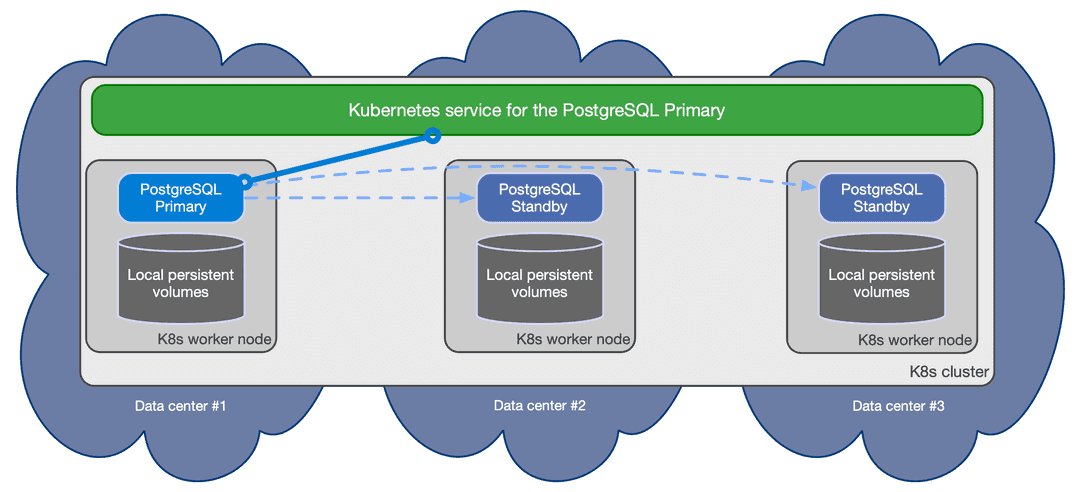
EDB Postgres® AI for CloudNativePG™ Cluster automatically takes care of updating the above services if
the topology of the cluster changes. For example, in case of failover, it
automatically updates the -rw service to point to the promoted primary,
making sure that traffic from the applications is seamlessly redirected.
Replication
Please refer to the "Replication" section for more information about how EDB Postgres® AI for CloudNativePG™ Cluster relies on PostgreSQL replication, including synchronous settings.
Connecting from an application
Please refer to the "Connecting from an application" section for information about how to connect to EDB Postgres® AI for CloudNativePG™ Cluster from a stateless application within the same Kubernetes cluster.
Connection Pooling
Please refer to the "Connection Pooling" section for information about how to take advantage of PgBouncer as a connection pooler, and create an access layer between your applications and the PostgreSQL clusters.
Read-write workloads
Applications can decide to connect to the PostgreSQL instance elected as current primary by the Kubernetes operator, as depicted in the following diagram:
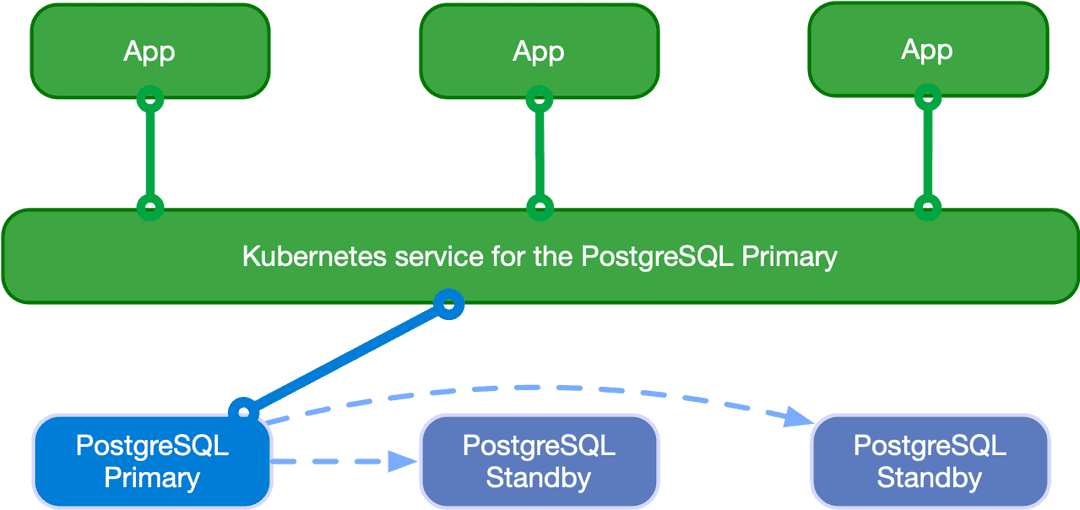
Applications can use the -rw suffix service.
In case of temporary or permanent unavailability of the primary, for High
Availability purposes EDB Postgres® AI for CloudNativePG™ Cluster will trigger a failover, pointing the -rw
service to another instance of the cluster.
Read-only workloads
Important
Applications must be aware of the limitations that Hot Standby presents and familiar with the way PostgreSQL operates when dealing with these workloads.
Applications can access hot standby replicas through the -ro service made available
by the operator. This service enables the application to offload read-only queries from the
primary node.
The following diagram shows the architecture:
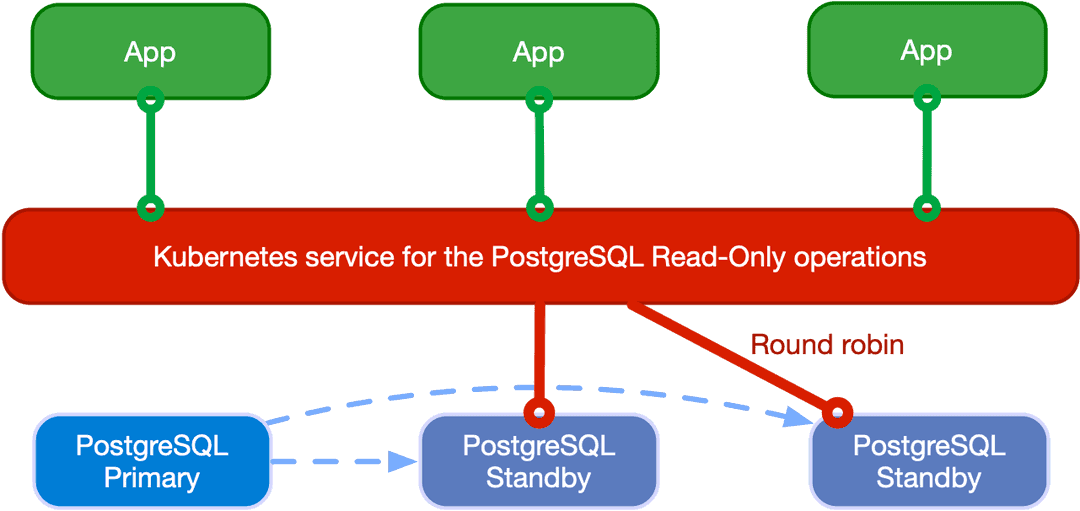
Applications can also access any PostgreSQL instance through the
-r service.
Deployments across Kubernetes clusters
Info
EDB Postgres® AI for CloudNativePG™ Cluster supports deploying PostgreSQL across multiple Kubernetes clusters through a feature that allows you to define a distributed PostgreSQL topology using replica clusters, as described in this section.
In a distributed PostgreSQL cluster there can only be a single PostgreSQL instance acting as a primary at all times. This means that applications can only write inside a single Kubernetes cluster, at any time.
However, for business continuity objectives it is fundamental to:
- reduce global recovery point objectives (RPO) by storing PostgreSQL backup data in multiple locations, regions and possibly using different providers (Disaster Recovery)
- reduce global recovery time objectives (RTO) by taking advantage of PostgreSQL replication beyond the primary Kubernetes cluster (High Availability)
In order to address the above concerns, EDB Postgres® AI for CloudNativePG™ Cluster introduces the concept of a PostgreSQL Topology that is distributed across different Kubernetes clusters and is made up of a primary PostgreSQL cluster and one or more PostgreSQL replica clusters. This feature is called distributed PostgreSQL topology with replica clusters, and it enables multi-cluster deployments in private, public, hybrid, and multi-cloud contexts.
A replica cluster is a separate Cluster resource that is in continuous
recovery, replicating from another source, either via WAL shipping from a WAL
archive or via streaming replication from a primary or a standby (cascading).
The diagram below depicts a PostgreSQL cluster spanning over two different Kubernetes clusters, where the primary cluster is in the first Kubernetes cluster and the replica cluster is in the second. The second Kubernetes cluster acts as the company's disaster recovery cluster, ready to be activated in case of disaster and unavailability of the first one.
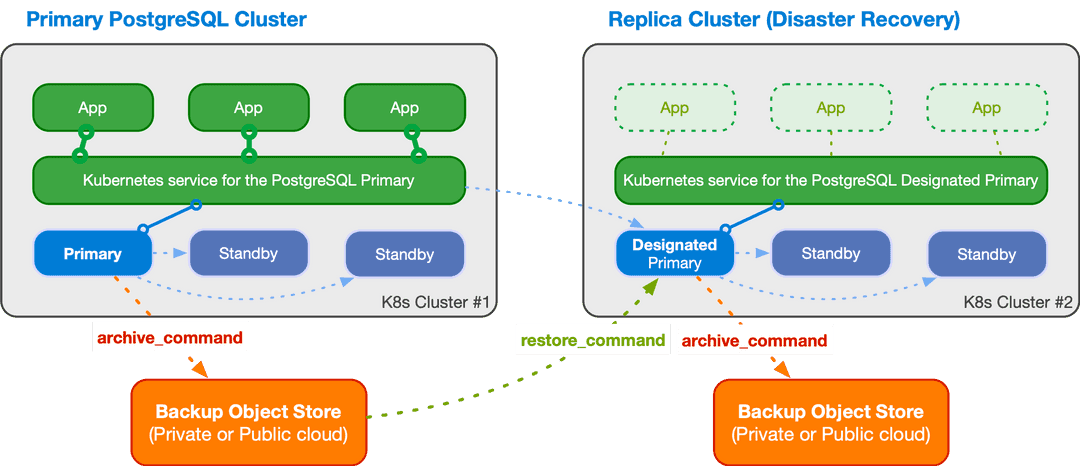
A replica cluster can have the same architecture as the primary cluster. Instead of a primary instance, a replica cluster has a designated primary instance, which is a standby server with an arbitrary number of cascading standby servers in streaming replication (symmetric architecture).
The designated primary can be promoted at any time, transforming the replica cluster into a primary cluster capable of accepting write connections. This is typically triggered by:
- Human decision: You choose to make the other PostgreSQL cluster (or the entire Kubernetes cluster) the primary. To avoid data loss and ensure that the former primary can follow without being re-cloned (especially with large data sets), you first demote the current primary, then promote the designated primary using the API provided by EDB Postgres® AI for CloudNativePG™ Cluster.
- Unexpected failure: If the entire Kubernetes cluster fails, you might experience data loss, but you need to fail over to the other Kubernetes cluster by promoting the PostgreSQL replica cluster.
Warning
EDB Postgres® AI for CloudNativePG™ Cluster cannot perform any cross-cluster automated failover, as it does not have authority beyond a single Kubernetes cluster. Such operations must be performed manually or delegated to a multi-cluster/federated cluster-aware authority.
Important
EDB Postgres® AI for CloudNativePG™ Cluster allows you to control the distributed topology via declarative configuration, enabling you to automate these procedures as part of your Infrastructure as Code (IaC) process, including GitOps.
In the example above, the designated primary receives WAL updates via streaming
replication (primary_conninfo). As a fallback, it can retrieve WAL segments
from an object store using file-based WAL shipping—for instance, with the
Barman Cloud plugin through restore_command and barman-cloud-wal-restore.
EDB Postgres® AI for CloudNativePG™ Cluster allows you to define topologies with multiple replica clusters. You can also define replica clusters with a lower number of replicas, and then increase this number when the cluster is promoted to primary.
Replica clusters
Please refer to the "Replica Clusters" section for more detailed information on how physical replica clusters operate and how to define a distributed topology with read-only clusters across different Kubernetes clusters. This approach can significantly enhance your global disaster recovery and high availability (HA) strategy.