Choose the recovery scenario that matches your infrastructure and recovery objectives. For an explanation of RTO, RPO, and other key concepts, see Concepts.
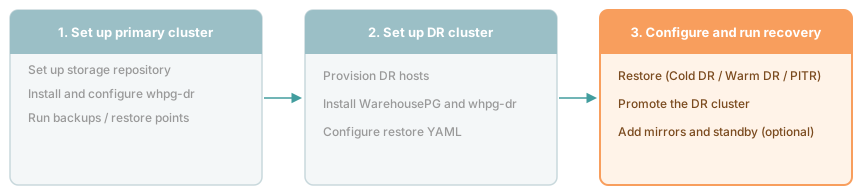
Recovery scenarios
Cold DR — The DR cluster doesn't exist until a failure occurs. You restore on demand from a base backup and WAL. Infrastructure cost is lowest, but Recovery Time Objective (RTO) is highest because provisioning and a full restore are required when a failure occurs.
Point-in-time recovery (PITR) — You restore the cluster to a specific named restore point: for example, to roll back data corruption caused by a bad ETL load or an accidental
DROP TABLE. The DR cluster may or may not be pre-provisioned. PITR requires restore points created in advance on the primary cluster.Warm DR — You provision the DR cluster in advance and replay WAL at a regular interval to keep it current. The cluster stays in recovery mode until you promote it. RTO is low because most of the WAL is already applied when a failure occurs.
Cold DR
Restore a WarehousePG cluster on demand from a base backup and WAL when a failure occurs.
Point-in-time recovery
Restore a WarehousePG cluster to a specific restore point to recover from data corruption or accidental data loss.
Warm DR
Keep a DR cluster continuously current by scheduling restore-point creation on the primary and delta WAL replay on the DR cluster.