Blueprint 2 · Agentic Analytics
Unified search, analytics, and agentic reasoning through one Postgres® interface.
Vector, full-text, and SQL queries converge in one Postgres-native platform—no data movement, no separate search infrastructure.
unified vector, full-text, and analytical queries
analyst data discovery time (BFSI)
queries run against operational data in place
How it's built
Architecture flow
How it works
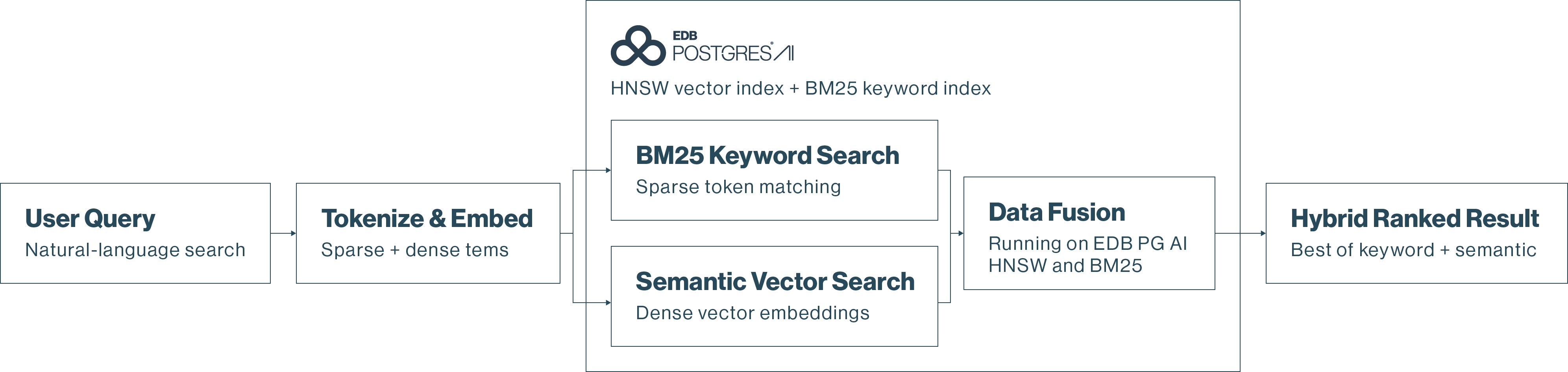
| 01 | QUERY | Custom applications, Grafana, and Metabase query EDB Postgres AI (EDB PG AI) through a standard Postgres interface—no separate search API required. All queries enter as SQL or through the PG MCP Server. |
| 02 | OPTIMIZE | The AIDB pipeline prepares all three search structures inside EDB PGD before any query executes—no external service required. pg_tokenizer converts raw text to BERT-tokenized BM25 sparse vectors (30,522-token BERT vocabulary). aidb generates 768-dim BERT dense embeddings stored in a pgvector HNSW index for semantic retrieval. Both structures update incrementally as new data arrives. |
| 03 | RETRIEVE | Three search arms execute in parallel. BM25 arm (pgvector search <&> operator): keyword relevance over BERT-tokenized text. Semantic arm (AIDB-managed pgvector HNSW <-> operator): conceptual similarity via 768-dim BERT embeddings. Analytical arm (PGAA): columnar SQL aggregates running directly against EDB PGD and Iceberg tables. RRF blends all three arms into a single ranked result set. No Elasticsearch, no external search service. |
| 04 | REASON | Reciprocal Rank Fusion (RRF) blends all three arms—BM25 keyword, semantic embedding, and PGAA columnar—into a single scored result set. Scoring is itself a reasoning step: results appearing across multiple arms signal high-confidence matches, eliminating single-method failure modes. Langflow optionally provides additional LLM-based reasoning over fused results, connecting to the AIDB pipeline—less core to the primary search flow, but available for deeper analytical insights. |
| 05 | SURFACE | Metabase, Tableau, and Grafana surface search results and fraud detection dashboards directly from EDB PGD. These are the visualization tools in the current open source release. |
Blueprint 2 · PARTNER STACK
Validated partners in this blueprint
Grafana
Kafka / Redpanda
Metabase
MinIO
Tableau
INDUSTRY USE CASES
Blueprint 2 in production
-
BFSIBFSI
Intelligent data discovery
A global investment bank's risk analysts spend 60% of their time locating and preparing data across 40+ siloed systems. Deploying unified semantic and keyword search across trading, risk, and compliance data—with PGAA accelerating analytical queries on operational data—eliminates the need to move data to a separate warehouse for every query.
-
HealthcareHealthcare
Ambient clinical intelligence
A top-5 health insurer processes 15M claims annually. Complex claims requiring clinical review average 12 days turnaround. Deploying agentic clinical reasoning via Langflow and PG MCP Server—with AI agents accessing vector search over clinical guidelines, structured member eligibility data, and longitudinal clinical history—enables consistent, governed claim adjudication at scale.
Validated deployment environments
Query operational data on-premises, in any cloud, or in hybrid environments—through the same Postgres interface.


See unified search, analytics, and agentic reasoning on your data.
Run hybrid queries—vector, full-text, and SQL—against operational and historical data through one Postgres interface. Talk to a solutions engineer.