

Future Leadership, Technology and Societal Changes
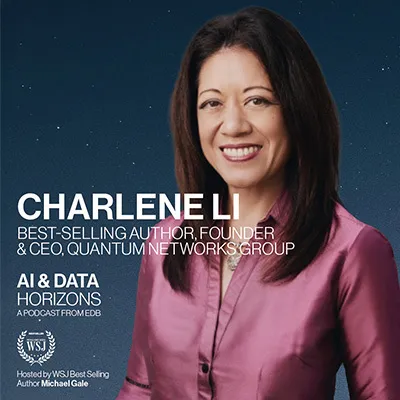
AI, quantum computing, and continuous change are redefining what it means to lead. Charlene Li, one of the world’s foremost authorities on digital leadership, shares how organizations can stay human, adaptive, and aligned in a world built on data.
Listen to the episode
Also available on:
Most enterprises are somewhere in the middle of a transformation they don't yet have the organizational infrastructure to complete.
The agentic workforce—humans and agents working in concert—is already a reality inside the organizations moving fastest. For everyone else, the systems, structures, and leadership needed to manage that combination are still being built. HR is being asked to orchestrate it all under a single coherent strategy, a management challenge that has no real precedent. And according to EDB’s global research, only 13% of organizations actually understand what that workforce looks like.
Diana Wu David has spent the last several years inside those organizations in boardrooms across Asia and the United States watching the gap grow wider between the ones crossing the chasm and the ones still circling it. What she keeps finding is that the distance has less to do with technology than with readiness: the right conversations at the board level, the right organizational structures, and a clear-eyed view of what managing an agentic enterprise actually demands from the people leading it.
Key takeaways:
- The agentic workforce is a management challenge as much as a technology one: Agents are becoming organizational actors working alongside humans, requiring oversight and demanding new leadership structures that most enterprises are still figuring out.
- Only 13% of organizations understand what the agentic workforce looks like: AI-native companies are already across the chasm. For large enterprises, Diana estimates roughly a year before that distance becomes structural.
- The right board conversation starts with opportunity: IKEA used AI to deflect over 50% of service calls, retrained those people, launched an interior design business it previously lacked the resources to build, and generated a billion dollars in new revenue. Boards focused only on risk are missing the more consequential question.
- The S-curve moment is closer than most boards think: Pilot purgatory is real, but enterprise-wide transformation is on the horizon. The winning organizations aren't waiting for a universal playbook, but rather building the internal conditions to move quickly when the moment comes.
Charlene Li has spent more than two decades studying why some organizations adapt to disruption while others fail. In this conversation, she reframes transformation as a discipline, not an event—one that AI and data now magnify exponentially. She explains how leaders can replace rigid hierarchies with networks of trust, empower experimentation, and measure success by learning velocity rather than quarterly returns. Two years later, her ideas have only gained momentum: in an age where every company is becoming an AI company, adaptability has become the ultimate differentiator.
Key takeaways:
- Make Change Routine: Sustained transformation comes from building systems that expect and reward constant evolution.
- Lead with Purpose and Data: Use AI-driven insights to guide decisions while keeping human vision at the center.
- Empower Experimentation: Innovation thrives when teams have permission to act, learn, and iterate quickly.
About the guest
Charlene Li, Best-selling author & Founder & CEO, Quantum Networks Group
Charlene Li is a pioneering analyst, author, and advisor whose research focuses on digital transformation and leadership in times of exponential change. A former Forrester Vice President and founder of Altimeter Group, she has helped hundreds of organizations build strategies that turn disruption into growth. Her latest work explores how AI and data are accelerating that journey.
More episodes

Cloning and Potential Impact on Society
How cloning, AI, and predictive modeling are converging to reshape the future.

Provoking Change in the Age of AI
Why great leaders don't predict the future—they provoke it through action, curiosity, and bold experimentation.

AI-Powered Care Delivery at Global Scale
How GE Healthcare is using AI to transform patient outcomes worldwide.