

Building Structural Integrity for the Agentic Enterprise
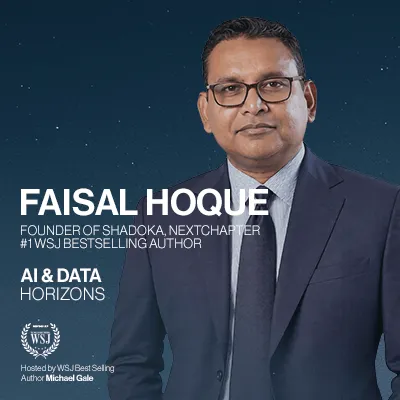
A conversation with Faisal Hoque, founder of SHADOKA and NextChapter and #1 Wall Street Journal bestselling author of Transcend, on why three decades of structural-integrity discipline now has to extend to autonomous agents, and why no organization should hand over more control than it can wind back down.
Listen to the episode
Also available on:
Agentic AI's rise gets framed mostly as a speed story: build faster, ship faster, out-iterate whatever shipped last quarter. Faisal Hoque argues that the same speed demands more discipline, not less. The pace at which people can now visualize and build a new product version didn't exist 18 months ago, he says—and an agent can be spawned in ten minutes, but this is no reason to let it loose inside somebody else's network. He calls that discipline structural integrity, which should be extended to autonomous agents and starting with fundamentals like how data is defined, how it's governed, and whether the network an agent runs on is sovereign or somebody else's. As agents move from assisting a human who reviews the output to acting on their own, he argues the bar on that foundation gets higher, not lower.
Asked what an escape mechanism for agentic AI should look like, Hoque reframed the question around reversibility: don't hand over a capability to govern something unless you can still wind it down or shut it off, the same override authority commercial pilots retain even on largely automated flights. That governance, he added, can't be purely technical. It also requires philosophical and leadership judgment about what's actually good for the people the system serves, the same discipline that separates leaders asking harder questions from the ones chasing an instant answer. In his experience, the latter are the ones who lose.
Key takeaways:
- The surprising adopters weren't who he expected. In his own companies' product testing, interns rejected AI-generated content outright, while middle managers—the group most often targeted for AI-driven cuts—turned out to be the fastest, most motivated adopters.
- Responsibility for agentic AI has four scales. Hoque names them explicitly: individual, organizational, national, and global. A framework for deciding who's accountable when an autonomous system does something no one approved.
- The stakes scale with the sector. He points to cancer-drug researchers, handlers of financial and patient data, and defense contractors as the clearest cases where structural integrity isn't optional.
- A cultural reckoning is already underway. Hoque cites recent philosophy-focused coverage, including a New York Times piece and his own contribution to Harvard Business Review, as evidence of what he calls a "qualitative awakening" around protecting human agency—one he says didn't exist even two years ago.
About the guest
Faisal Hoque, Founder of SHADOKA, NextChapter
Recognized as one of the world’s leading management thinkers and technologists, entrepreneur Faisal Hoque has spent three decades helping Fortune 500 companies and U.S. government agencies humanize organizational transformation, and is now focused on unlocking human-centric value in the age of AI. He is the founder of SHADOKA and NextChapter, an Executive Fellow at IMD, author of 12 books, including #1 The Wall Street Journal, USA TODAY, and Los Angeles Times bestsellers, and writes regularly for Fast Company, I by IMD, Harvard Business Review, Psychology Today, and other publications.
More episodes
Retraining the Workforce for the AI Economy
Why leaders who underestimate reskilling their people are the ones most likely to fall behind.
The Decision Engine That Makes Enterprise AI Scale
Why most enterprise AI stalls not for lack of technology, but for lack of a real problem to solve.
Governing Agentic AI at Enterprise Speed
Why governance for an agentic workforce must start at the data layer.