The Canvas or the Function: AIDB vs. Langflow for Agentic AI Ops on EDB Postgres AI

A follow-up to The Architecture IS the Security: Building Sovereign AI Ops on Postgres with EDB Agent Factory
The recommendation
In the previous post, I made the case for running an AI-driven incident-response pipeline entirely inside a Postgres cluster: pgvector for retrieval, EDB Postgres AI Hybrid Manager’s on-board model serving for inference, AI Studio powered by Langflow for orchestration, and a regular Postgres table for the audit trail. The architecture collapsed data egress, per-token cost, and audit correlation into a single boundary.
One component in that stack was not Postgres: the Langflow runtime. This post examines what happens when that last piece moves into the database too. I rebuilt the same incident-response pipeline as native SQL using the EDB Postgres AI Database (AIDB) extension: no Langflow runtime in the loop, and one PL/pgSQL function replacing the sixteen-node canvas. Same models, same runbooks, same policy gate, same audit table, same console.
The recommendation is not that one approach replaces the other. Both are legitimate ways to build on EDB Postgres AI Agent Factory, and the right choice depends on who is building, how often the flow changes, and how small you need the operational footprint to be. Use Langflow when the pipeline is still being designed, when the team iterates visually, or when non-SQL builders own the flow. Use AIDB when the pipeline has stabilized, when the team lives in SQL, or when you want the stack reduced to “it is literally just Postgres.”
The rest of this post walks through the rebuild, the node-by-node mapping, and the trade-offs in both directions.
The observation that made the rebuild possible
When I looked at the Langflow flow from the first post node by node, something stood out: Almost every node was already an EDB or Postgres component. The embedder is called the Hybrid Manager embedding model. The retriever queried pgvector. The triage agent and three specialists called the Hybrid Manager inference endpoint. The audit writer inserted into a Postgres table. Langflow was contributing two things: the orchestration glue between those calls, and the visual canvas to arrange them on.
AIDB exposes every one of those primitives as a SQL function. aidb.encode_text() embeds. aidb.retrieve_text() retrieves. aidb.decode_text() runs inference against a registered model. That means the engine of the pipeline (retrieval, inference, policy, audit) does not change at all in the rebuild. Only the orchestration moves, from a canvas into a function.
The full mapping:
| Langflow node | SQL / AIDB equivalent |
|---|---|
| ChatInput | ops.handle_alert(p_alert_text) argument |
| Embeddings component | embedding-dgx model registered via aidb.create_model() |
| Postgres hybrid retriever | aidb.retrieve_text('ops.pipeline_ops_runbooks_kb', alert, k) |
| Triage prompt + model | aidb.decode_text('nemotron-3-nano', ...) returning strict JSON |
| ConditionalRouter | a policy CASE on autonomous_safe + confidence |
| Three specialist agents | three aidb.decode_text() calls |
| Synthesizer + output cleaner | string assembly in PL/pgSQL |
| Audit table writer | INSERT INTO ops.incident_audit |
Sixteen nodes become one function, ops.handle_alert(alert_text). The existing ops console needed a one-function change to support it: Instead of POSTing to the Langflow REST endpoint, it runs SELECT ops.handle_alert(...). The output contract is identical, so the console’s parsers, triage card, agent tabs, and MTTR timer work unchanged against either backend.
What the AIDB version looks like
Three excerpts show the shape of the rebuild.
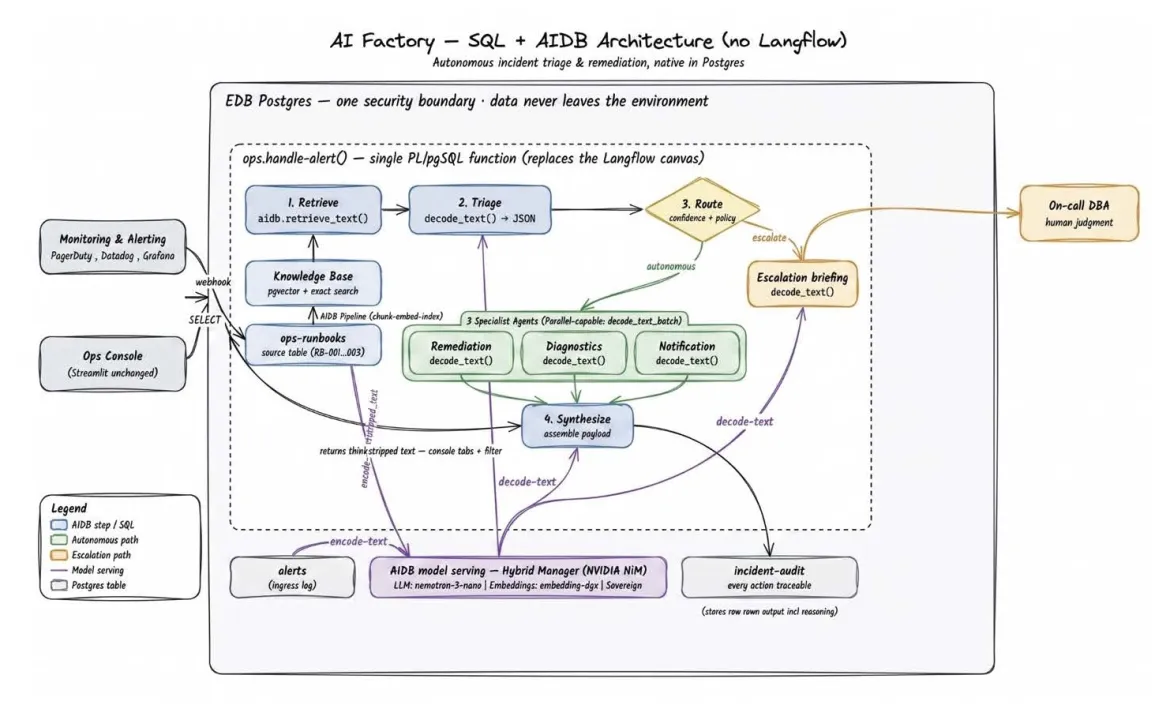
Retrieval is one SQL call. In the first post, runbook chunks were embedded into an ops_runbooks table and queried with a pgvector ORDER BY embedding <=> $1 statement that the Langflow retriever node wrapped. In the AIDB version, an AIDB pipeline owns chunking and embedding, and retrieval becomes:
SELECT r.key
  INTO v_rb_key
  FROM aidb.retrieve_text('ops.pipeline_ops_runbooks_kb', p_alert_text, 1) AS r
  ORDER BY r.distance ASC
  LIMIT 1;
The pipeline behind that knowledge base is itself declared in SQL: ChunkText splits each runbook into overlapping chunks so long markdown stays within the embedding model’s token limit, then KnowledgeBase embeds each chunk:
SELECT aidb.create_pipeline(
    name               => 'ops_runbooks_kb',
    source             => 'ops.ops_runbooks',
    source_key_column  => 'id',
    source_data_column => 'content',
    step_1             => 'ChunkText',
    step_1_options     => aidb.chunk_text_config(
        desired_length => 200, max_length => 250,
        overlap_length => 40, strategy => 'words'),
    step_2             => 'KnowledgeBase',
    step_2_options     => aidb.knowledge_base_config(
        model             => 'embedding-dgx',
        data_format       => 'Text',
        distance_operator => 'Cosine',
        vector_index      => aidb.vector_index_disabled_config())
);
This is a quiet but meaningful upgrade over the first architecture. AIDB keeps the knowledge base in sync as the source table changes: Adding a runbook means dropping a new markdown file in the runbooks directory and rerunning the loader. There is no separate embedding script to keep aligned with the source rows, because the pipeline is the alignment.
Inference is a function call against the same Hybrid Manager models the Langflow version used. The triage step:
v_triage_raw := aidb.decode_text('nemotron-3-nano', format(
$p$You are an EDB Postgres ops triage agent. Output strict JSON only, no prose, no code fence.
ALERT:
%s
RETRIEVED RUNBOOK (%s):
%s
...$p$, p_alert_text, v_rb_key, left(v_rb_content, 4000)));
The models are registered once. aidb.sync_hcp_models() picks up the Hybrid Manager completion model automatically; the embedding model is registered explicitly against its current in-cluster URL via aidb.create_model(). After that, model access is a name in an SQL call: no API keys in the flow, no endpoint URLs in node configuration.
The router, the piece I argued in the first post matters most, survives the translation intact, and this is the point I want to emphasize. The policy gate is deterministic code in both versions. In Langflow it was a ConditionalRouter node; in SQL it is:
IF coalesce(v_rb_safe, false) = false OR v_confidence < p_confidence_threshold THEN
    v_mode := 'escalate';
ELSE
    v_mode := 'autonomous';
END IF;
The runbook’s safety flag and the confidence threshold decide whether the agent’s reasoning is allowed to act. The model proposes; the policy disposes. Notably, the policy here overrides even the model’s own suggested resolution_mode: If the LLM says “autonomous” but the runbook is not flagged autonomous-safe, the case escalates. The disk-space runbook (RB-003) still routes to a human every time, with a pre-assembled escalation briefing, exactly as it did on the canvas.
Where the time goes
The end-to-end latency of either Langflow or the AIDB version decomposes into four parts: retrieval, inference, orchestration overhead, and the audit write.
Retrieval and the audit write are the same query and the same insert in both versions, and both are milliseconds. Inference is using the same models on the same Hybrid Manager serving pods in both versions, and it is seconds per call. That leaves two real differences: orchestration overhead, and specialist concurrency.
Orchestration overhead is noise. In the Langflow version, each node boundary costs a dispatch inside the runtime, and each database-touching node costs a network round trip from the Langflow pod to the cluster, plus one HTTP hop from the webhook to the flow’s REST endpoint. Those are single-digit milliseconds each, tens of milliseconds across the whole flow. In the AIDB version they collapse into local function calls inside one backend. Against inference calls measured in seconds, this difference is under one percent of end-to-end time in either direction. This is the quantitative version of the “same primitives” argument: The canvas does not make the pipeline meaningfully slower, and removing it does not make the pipeline meaningfully faster. Measured end to end, the escalation path bears this out. RB-003 has no parallelism to lose (a single briefing call in both versions), and the two backends land within run-to-run inference variance of each other: 45 seconds on Langflow, 53 seconds on AIDB.
Specialist concurrency is the real number. On the autonomous path, the pipeline makes four inference calls: one triage call, then three specialists. Langflow runs the specialists as parallel branches, so its wall clock is roughly triage plus the slowest specialist. The straightforward PL/pgSQL translation runs them in sequence, so its wall clock is roughly triage plus the sum of all three. If the specialists take similar time, call it N seconds each. The sequential version pays about 2N extra per autonomous incident, taking the inference portion from roughly two call-times to roughly four.
On the demo cluster, the same connection-pool scenario (RB-001) resolves end-to-end in 70 seconds on Langflow and 114 seconds on AIDB sequential. That 44-second gap is consistent with two extra specialist call times of roughly 22 seconds each, and nothing else: The same scenario shows no comparable gap on the single-call escalation path. Both versions record their own timing, so the comparison is reproducible: The console’s MTTR timer captures the Langflow path, and the AIDB function writes latency_ms into the audit table on every call.
The honest statement is that Langflow gives you parallelism by default and AIDB makes you ask for it. Each autonomous incident costs roughly two extra specialist call times. For a pipeline handling a dozen incidents a week, that is an operator watching a timer for extra seconds, not a capacity problem. Under sustained load it also holds a database backend longer per incident, which is a connection-budget question worth answering before high-volume deployment.
What you gain by moving to AIDB
The footprint shrinks to one system. To be clear, the Langflow version was already sovereign: The runtime lives on-prem inside the Hybrid Manager environment and no data crosses the boundary. What this version removes is the runtime itself. There is no Python process between the alert and the audit row: The attack surface, the patching surface, and the deployment surface are all the Postgres cluster you already operate. For teams whose security review asks “enumerate every process that touches incident data,” the answer is now one word.
Orchestration state and data live in the same transaction scope. The function persists the inbound alert, runs retrieval, inference, routing, and writes the audit row in a single call. There is no window where the flow has acted but the audit trail has not caught up, and no failure mode where the orchestrator succeeded but the audit write to a remote database failed.
Version control gets simpler. A Langflow flow exports as JSON, diffable in principle, but reviewing a node-graph diff in a pull request is not a natural act. The AIDB version is six SQL files. A change to the triage prompt or the confidence threshold is a readable diff, reviewed the way the team already reviews schema migrations.
One fewer thing to run. No Langflow pods, no Langflow upgrades, no Langflow-to-database connection pool to size. If you still want the “one REST endpoint plus API key” integration story from the first post, PostgREST exposes ops.handle_alert over HTTP: same single endpoint, still no orchestration runtime.
What you give up
Honesty requires the reverse list, and it is not short.
The visual canvas is a real loss. The drag-and-drop view of the pipeline is not just a demo flourish. When a new team member asks how the pipeline works, the canvas answers in 10 seconds. When a product owner wants to understand where the escalation decision happens, pointing at the ConditionalRouter node beats walking them through a PL/pgSQL function. Langflow is also where experimentation is cheap: Swapping a retriever, adding a re-ranking step, or trying a different prompt template is a canvas edit, not a function rewrite.
Parallelism takes work. In Langflow, the three specialist sub-agents (Remediation, Diagnostics, Notification) run concurrently by construction: parallel branches on the canvas. In the straightforward PL/pgSQL translation they run sequentially, because a function body executes top to bottom. AIDB offers aidb.decode_text_batch() and background workers to restore concurrency, but that is an optimization you have to reach for rather than a property you get for free. If per-incident latency matters, budget for it.
LLM calls inside a database function are long-running calls inside a database function. Each aidb.decode_text() blocks the backend for the duration of the inference. For an incident-response pipeline handling a dozen alerts a week this is irrelevant; for high-frequency invocation you want to think about connection budgets and statement timeouts in a way the external-orchestrator pattern lets you ignore.
PL/pgSQL is the orchestration language, for better and worse. Structured error handling around model output is doable; the rebuild wraps JSON extraction in an exception block that fails safe to escalation when the model's output does not parse. But the ecosystem of pre-built components, integrations, and community flows that Langflow ships with has no SQL equivalent. Every node you would have dragged in is a function you write.
Team fit is the real constraint. If the people who own this pipeline are DBAs and SQL-fluent SREs, the AIDB version is more maintainable than the canvas, not less. If the pipeline is owned by an AI engineering team that thinks in flows and components, forcing them into PL/pgSQL trades their productivity for architectural purity.
The decision, in table form
| Consideration | Favors Langflow | Favors AIDB |
|---|---|---|
| Pipeline maturity | Still designing and iterating | Stable, changes are rare and reviewed |
| Team | AI engineers, mixed-skill builders | DBAs, SQL-fluent SREs |
| Security review scope | Cluster plus one on-prem runtime | Cluster only |
| Concurrency | Parallel branches by default | Sequential unless you use batch/background execution |
| Change review | Visual inspection on the canvas | SQL diffs in pull requests |
| Explaining the flow | The canvas is the documentation | The function is the documentation |
| Runtime footprint | Langflow pods + cluster | Cluster only |
There is also a sequencing answer, which is the one I would give most teams: Build on the canvas, ship in SQL. Langflow is where the pipeline gets designed, where you discover that the router needs a runbook-level safety flag, that the triage output must be strict JSON, that escalations need a pre-assembled briefing. Once those decisions have stopped changing, the flow’s nodes are already Postgres components, and the translation to a function is mechanical. The mapping table above is that translation.
What did not change, and why that is the point
It is worth being precise about what the rebuild did not touch, because it is the strongest argument for the platform underneath both options.
The models did not change: the same Hybrid Manager–served instruction-tuned model and embedding model, still with no per-token charge and no data egress. The runbooks did not change. The policy gate did not change: a boolean on the runbook plus a numeric confidence threshold, deterministic in both versions. The audit table did not change: one queryable Postgres row per incident, retrievable with a SELECT when the security team asks what the agent did at 02:14 last Tuesday. The console did not change beyond one function call, and it can target either backend from a sidebar toggle.
That is the property I care about most as these systems evolve. The orchestration layer, the part of the agentic AI stack currently moving the fastest, turned out to be swappable because everything that carries risk and cost (the data, the models, the policy, the audit trail) already lived in Postgres. The first post argued that the architecture is the security. The follow-up lesson is that the architecture is also the optionality: When your primitives live in the database, the orchestrator is a choice you can revisit, not a decision you are locked into.
Summary
Langflow and AIDB are two orchestration options over the same sovereign engine: Hybrid Manager model serving, pgvector retrieval, deterministic policy routing, and a Postgres audit trail. Langflow gives you a visual canvas, cheap iteration, default parallelism, and a component ecosystem, at the cost of one additional runtime. AIDB gives you an end-to-end pure-Postgres stack, transactional orchestration, SQL-native change review, and one fewer system to operate, at the cost of the canvas and free concurrency. Choose based on team and maturity or design on the canvas and ship in SQL, since the node-to-function mapping is direct. Either way, the parts that matter (the data, the models, the policy gate, and the audit log) never leave the cluster.