Built From the Data Up: A Trusted Foundation for the Agentic Era | EDB Postgres® AI Q2-2026 Release

This blog is co-authored by Lizzy Nguyen, Maeve Sullivan, and Jack Christie.
The agentic era demands more from the data layer.
Every modern enterprise is asking the same question: how do we move AI agents from experimentation into production, safely and at scale?
These agents reason, decide, and act on behalf of people at near-instantaneous speed. That raises the bar for everything beneath them: trusted data, dependable performance, and governance fast enough to keep up.
When we talk to customers about this, the same tensions surface. They tell us a lack of infrastructure agility, and the fear of losing control over their data, keeps them from trusting AI agents in production, even under internal pressure to adopt them. So we decided early that rather than build a bolt-on AI layer, we would build from the data up. This quarter, we’ve embedded intelligence across the entire platform so enterprises can act on data they own, in environments they control, at the speed AI actually demands.
Today, we delivered ten new or enhanced capabilities that give enterprises a resilient foundation to deploy and scale trustworthy AI without sacrificing sovereignty or control. Highlights in this blog include:
- Agentic Database: self-optimizing Postgres that tunes, scales, and resolves issues on its own, giving your agents the performance and availability needed to operate at scale.
- Converged Analytics, including new EDB PG AI for ClickHouse: bringing real-time, historical, and operational data on one foundation with no ETL.
- Agent Factory: independently benchmarked to deliver fast, accurate vector search directly in Postgres, a solid foundation for running agents.
- AI and Data Governance (in preview): agent governance enforced at the data layer.
Read on for a closer look.
Agentic Database: a self-optimizing foundation
Building from the data up starts with the database itself. To keep your database operating at the speed and scale agents require, EDB PG AI’s new agentic database capabilities transform Postgres from a manually operated system into a self-optimizing one. Built on over 20 years of EDB's Postgres expertise, EDB PG AI now continuously monitors more than 200 operational and performance metrics, determines how best to optimize and, where your enterprise policy allows, applies the change itself. It tunes, scales, and resolves issues before they become incidents, like a senior DBA but who never has to get paged.
At the core is a new automation engine that turns recommendations into action on your terms. Today it can automatically apply recommended indexes, scale CPU and memory when usage crosses your thresholds, and keep clusters current with automated minor and patch updates. A recommendation scorecard grades cluster health across indexes, statistics, configuration, and security, and surfaces the exact fix. An always-on AI assistant, connected live to your cluster, answers questions grounded in what the database is doing right now: real queries, real execution times, real table structures.
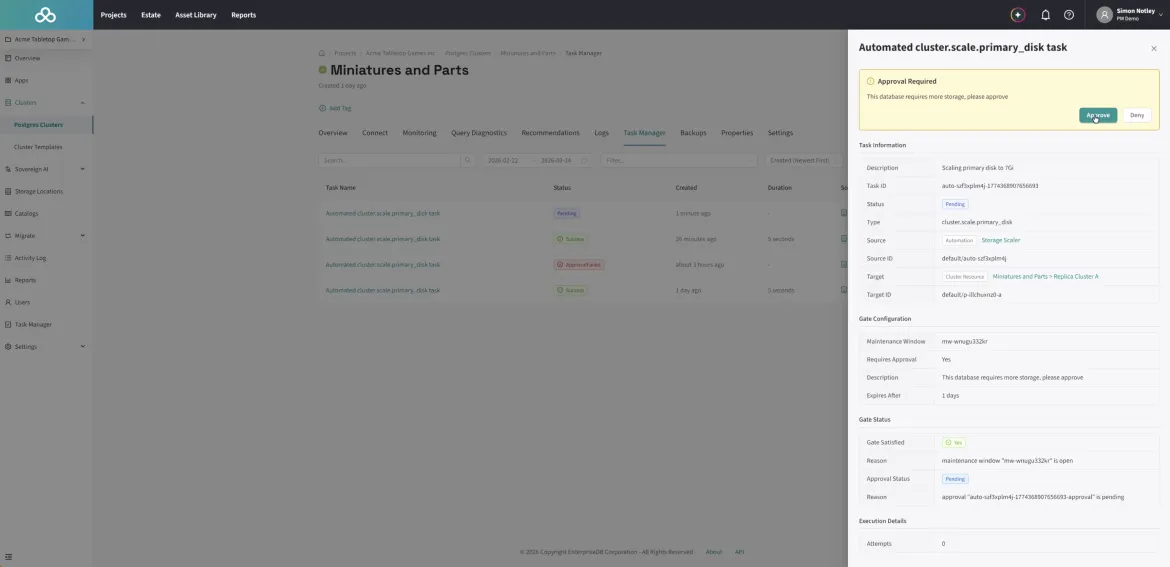
Crucially, automation never comes at the expense of control. Your team decides which actions are done automatically, require human approval, or wait for a scheduled maintenance window. Every action (executed, pending, or rejected) is captured in a full audit trail, and the same advisory layer is exposed over MCP, so your own AI agents can work through the same expertise and the same guardrails.
The result is measurable: database tuning up to 10x faster. Work that took an expert DBA 60 to 90 minutes of manual digging now takes just a few, as the platform spots the problem, recommends the exact fix in seconds, and applies it where policy allows. Those same optimizations accelerate application performance by up to 8x for end users, and teams can shift their expertise from firefighting to high-value work.
Converged Analytics: real-time to petabyte scale, under your control (now GA: EDB PG AI for ClickHouse)
A database that runs itself is only half the story. Your data also has to answer questions, instantly and at every scale, so EDB PG AI now collapses the gap between operational and analytical data. Using a zero-ETL architecture, it publishes live Postgres data to an open Apache Iceberg catalog: a single, always-current source of truth that every engine, and every agent, reads from without export hops or reloads.
That unified catalog is what lets EDB PG AI answer every analytical question on one platform:
- What's true in my system of record? (transactional Postgres)
- What happened before? (EDB PG AI for WarehousePG, for petabyte-scale historical analysis)
- What's happening right now? (EDB PG AI for ClickHouse)
Answering that last question is EDB PG AI for ClickHouse, generally available as part of this release. It delivers sub-second analytics on live event and log data — fraud scoring, live dashboards, observability, agent context — and it is the only path to enterprise ClickHouse that arrives already connected to Postgres, sovereign by design, deployable wherever you require.
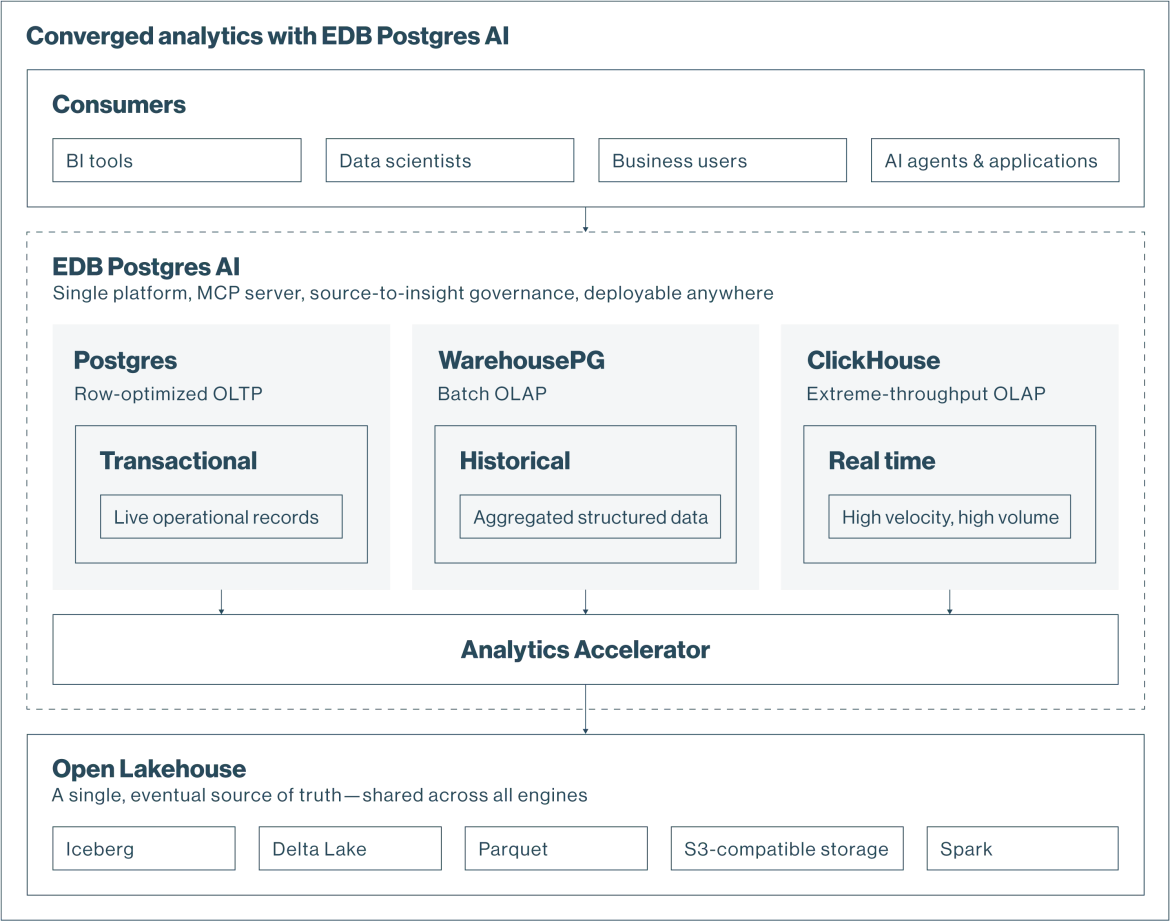
EDB PG AI for ClickHouse reads from the same open Iceberg catalog as Postgres and WarehousePG without custom connectors, ETL, or second copy of the data. That means that the moment a transaction lands in Postgres, EDB PG AI can query it in milliseconds. This is especially important for enterprises running use cases that can’t tolerate any delays, including:
- Live event context for AI agents: Feed real-time event data into the agent context layer via MCP, enabling sub-second decisions across the full analytical estate.
- Real-time fraud & risk monitoring: Ingest transaction events and return a risk score in milliseconds so fraud agents can query live signals and historical patterns in the same loop to catch fraud before the transaction clears.
- Operational observability: Use an OpenTelemetry-native time-series and log analytics backbone to feed live dashboards and keep SRE teams ahead of incidents.
- AdTech & digital analytics: Attribution, A/B testing, and conversion tracking at web scale.
These are workloads where ClickHouse is already the dominant open source choice, now met with EDB PG AI's enterprise reliability.
By bringing operational data, real-time analytics, and petabyte-scale warehousing together on a sovereign foundation, EDB PG AI delivers up to 58% lower total cost of ownership with predictable per-core pricing and up to 52% greater scaling efficiency for high-concurrency workloads compared to cloud data platforms, with a migration path measured in hours, not months.
Check out how that works in this new demo:
The best foundation to run agents
This unified data layer gives agents what they depend on most: fast, accurate, and current retrieval on data they're already authorized to access. EDB PG AI also brings structured data, always-current knowledge bases, and vector search together in Postgres, with no separate systems to bolt on.
The key word is current. Knowledge bases are kept in sync by automated pipelines: as your source data changes, embeddings are regenerated and re-indexed automatically, so agents retrieve from what's true now rather than a stale snapshot. And because retrieval runs inside Postgres, EDB PG AI returns the right results quickly, without you adding new systems to your data stack.
New independent benchmarks by McKnight Consulting Group tested EDB PG AI against leading platforms, including Databricks and MongoDB, across the demands of real-world AI agent workloads. EDB PG AI delivered up to 99.4% lower query latency than Databricks and 93% lower than MongoDB, while achieving the highest accuracy of any platform tested, 17% above Databricks and 26% above MongoDB. The result is the sub-second speed and the accuracy autonomous agents demand, without architectural compromise. Deep dive on these results here.
NTT East, one of Japan's leading telecommunications carriers, is using EDB PG AI to pursue AI-driven network operations. They are building AI agents that autonomously detect, analyze, and respond to network issues, all within a private environment where sensitive operational data stays under the carrier's control.
Governance at the data layer (now in preview)
As these agents take on more enterprise work, the hardest question isn't just what they can do; it's how to keep them inside the rules. Most approaches tell you what happened after an agent has already acted. EDB PG AI takes a different path: it extends the same trusted governance you already use for your database to agents, enforced at the data layer that every query must pass through and that policy can't be routed around. The database validates an agent's declared purpose before it executes, using native Postgres roles and row-level security rather than a separate governance tool bolted on top.

Available in preview today, EDB PG AI provides the foundation for enterprise-wide agent governance, including a new audit log viewer that tracks every agent's identity, purpose, and whether that action was allowed or blocked by the database. This gives your compliance, risk, and finance teams the assurance they need to approve your AI projects, and you get the sign-off you need to ship your agents. See how this works in a demo:
Later this year, we will expand our governance framework so that the platform flags when an agent's behavior drifts from its stated purpose. As agent governance evolves, our principle stays constant: autonomous agents held to enterprise policy, enforced at the source. To learn more about our governance strategy, check out this podcast by our VP of Product Management.
Featured capabilities, built for the outcomes customers asked for
These four advances headline the release, but they're part of one platform. Here are all ten new or enhanced capabilities, each built around an outcome customers asked us for:
- Agentic Database: self-optimizing Postgres that tunes, scales, and resolves issues on its own, within your guardrails.
- Converged Analytics: one answer to every analytics question. Real-time, historical, and operational analytics on one open foundation, now with EDB PG AI for ClickHouse.
- Agent Factory: building on Postgres's proven foundation for applications to deliver the best database for agents. Build, test, and launch sovereign AI at scale.
- AI and Data Governance (in preview): agent and data governance enforced at the data layer.
- Distributed High Availability: transform Postgres into a data platform built to never stop. Always-on for businesses that can't afford a second of downtime.
- Agentic Migration: a faster way off legacy and cloud-locked databases. AI-driven migration off Oracle and others, in days rather than years.
- Warehouse Analytics: petabyte-scale analytics on open source you control. No cloud-warehouse bill or vendor lock-in.
- Hybrid Manager: a single console to deploy, manage, and observe your entire Postgres estate.
- Sovereign Data and AI Factory: a turnkey, AI-ready engineered system delivered with Dell,HP, IBM, Supermicro, and optional NVIDIA GPUs.
- Open Source (OSS) Library: open source tools, ready to launch from your secure environment, so you can stay open and run with confidence.
To sum it up
This quarter, we prioritized the needs of the increasingly agentic enterprise, delivering one platform where operational data feeds insights, those insights inform your agents, and the agents act on the live data underneath, without compromising sovereignty or integrity.
Ready to get started? Reach out to us today.