
Break Agentic Performance Bottlenecks
This report compares the flexible vector indexing options on EDB Postgres AI — so you can power vector search at any scale.
The challenge: Agents push your vector index to its limits
- Parallel agent queries have zero tolerance for latency spikes.
- pgvector wasn't designed for indexes that don't fit in memory.
- A weekend maintenance window every time you refresh your index isn't sustainable.
The solution: EDB Postgres AI — the right index at any scale
20x
Higher throughput at scale
When indexes outgrow available RAM, pgvector’s random I/O collapses throughput. VectorChord’s sequential architecture doesn’t — delivering 20× more queries per second on the same hardware at 1B vectors.
13x
Faster index builds at 1B vectors
VectorChord builds a 1B-vector index using 64 MB of memory; pgvector needs up to 1 TB and nearly 16 hours — turning a production index rebuild from a weekend outage into a routine operation.
50–75%
Lower P99 latency under concurrent load
IVF-RaBitQ scans a fixed number of lists regardless of query difficulty, producing tight, predictable latency distributions even as concurrency increases — exactly what agentic applications require.
Validated performance
Dataset | Engine | shared_buffers | Recall | 32-Client QPS | P99 |
|---|---|---|---|---|---|
100M vectors | VectorChord | 16 GB | 0.95 | 4,644 | 8.9ms |
100M vectors | pgvector | 256 GB | 0.95 | 1,917 | 33.0ms |
1B vectors | VectorChord | 128 GB | 0.95 | 1,267 | 35.7ms |
1B vectors | pgvector | 256 GB | 0.95 | 818 | 66.9ms |
All results: i7i.metal-48xl, 32 concurrent clients, best-case shared_buffers per engine, March 2026. Source: Appendix B in performance report.
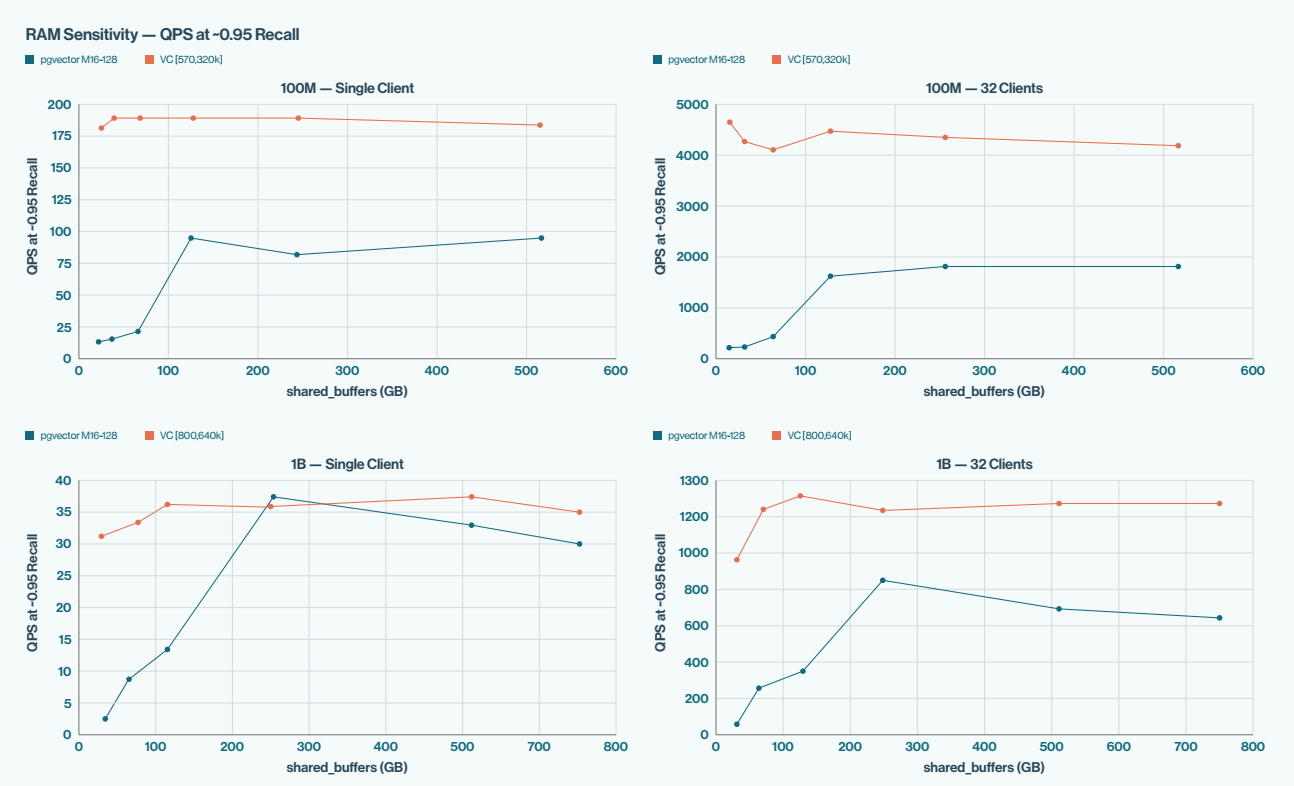
“VectorChord is nearly immune to server memory sizing. QPS varies less than 10% across shared_buffers sizes from 16 GB to 512 GB. pgvector requires precise memory tuning and suffers a double-buffering penalty at intermediate sizes.”