

Stop the process. Swap the packages. Restart.
EDB Postgres® AI (EDB PG AI) for WarehousePG is binary-compatible with Greenplum 6.x and 7.x. Your data stays on disk, your schema stays as written, your applications don't know it happened. Euronext FX cut over in hours—after months of planning. That ratio is the point.
Why Greenplum estates are moving
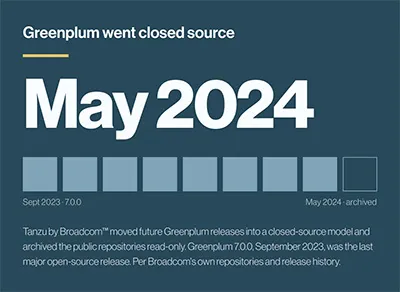
The open source option closed
Greenplum's core engine was open source from 2015. In May 2024 that changed: future releases ship closed-source inside the vendor's commercial suite, and the public repositories were archived read-only.
Four owners since 2010
EMC in 2010, Pivotal in 2012, VMware in 2019, Broadcom in November 2023—each a matter of public record. What follows a change of owner is a decision for that owner to make, which is precisely what makes it hard to plan around.
Self-supporting a fork is a real job
The community fork route is legitimate, but somebody owns CVE response, patching, and packaging. Teams that take it on usually discover the cost at 3am in an emergency, rather than in the business case.
There is no deadline here. Greenplum has no publicly published end-of-life date—entitled customers can see per-version lifecycle dates in Broadcom's support portal, but there is no public countdown, and anyone implying otherwise is inventing urgency. The citable event is the May 2024 license change. That changes your options, not your timetable.
What a binary swap actually means
Most migrations move your data. This one doesn't. WarehousePG is an Apache-licensed fork of the last open source Greenplum release, so the swap replaces the executables and leaves everything else where it is: stop the Greenplum process, remove the old packages, install the WarehousePG packages, restart the database.
What you have today | After the swap | Notes |
|---|---|---|
On-disk data | Unchanged | No data movement. This is the whole point—and the reason cutover is measured in hours rather than weekends. |
Schema, including distribution keys | Unchanged | No redesign, no redistribution, no partitioning rework. |
Client applications, ports, drivers | Unchanged | Postgres wire protocol throughout. Applications don't need to know. |
BI, ETL and DBA tooling | Unchanged | Including scheduled administration jobs. |
MPP topology | Same architecture | Coordinator plus segments, interconnect, segment mirroring, standby coordinator. WarehousePG is the fork, not a re-implementation. |
MADlib, PXF, PostGIS, PL/R, PL/Java, PL/Container | Supported | In-database ML, external tables to HDFS and object storage, ORC/AVRO/Parquet. |
Proprietary commercial add-on modules | Not included | Commercial modules from the proprietary suite aren't in an Apache-licensed fork. EDB's stated approach is replacements via new development, partnerships and integrations. Scope this explicitly—it's the most likely technical objection. |
Two qualifiers, stated up front
Binary compatibility is scoped to Greenplum 6.x and 7.x.
7.x is the direct swap. On 6.x there are two steps: swap the binaries, then move the cluster to WarehousePG 7.x with EDB Professional Services. There is no published compatibility claim for Apache Cloudberry or other forks; if you're on one, that's a different conversation, and one worth having before the planning starts rather than during it.
“Zero migration” means no data movement and no schema change. It does not mean no project.
Euronext FX describes months of preparation before a cutover that took hours. The planning is real; what disappears is the data migration.
Two estates, two different problems
“We're excited to be working with EDB Postgres AI. Its support for Greenplum workloads is helping us maintain control of where and how we deploy open source software.”
— Grigoriy Zeleniy, Global CTO, Euronext FX

A 24/5 electronic communication network for spot FX, precious metals, and NDFs, serving banks, hedge funds, and institutions with no tolerance for disruption. Moved off Greenplum after it went closed source, to keep control of where and how it deploys open source software. Cutover took hours, not days.
Euronext FX

Connected-TV analytics. Took the community-fork route via Apache Cloudberry when Greenplum licensing changed, then spent a year self-supporting it. “After a year of bumps and bruises, we knew we needed something more stable.”
— Greg Spiegelberg, MNTN
BENCHMARKED AGAINST CLOUD WAREHOUSES
lower total cost of ownership
more consistent under high concurrency
TPC-DS benchmark scale
What changes, once the binaries are swapped
Where the swapped cluster runs
Take it to your team
Governance
Brief

Technical Migration
Playbook
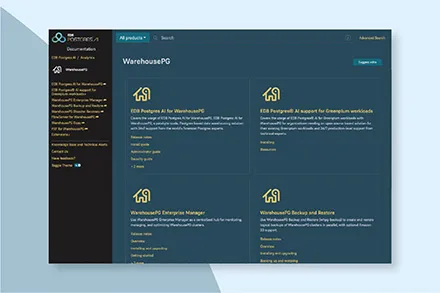
WarehousePG
documentation

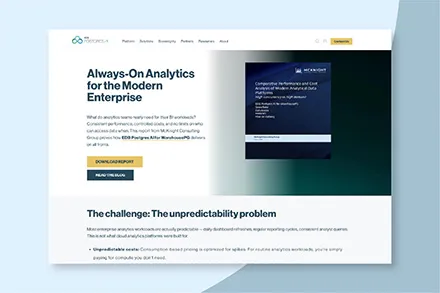
McKnight Consulting Group
benchmark
Is your Greenplum cluster a straight binary swap?
The answer depends mostly on your Greenplum version and which commercial modules you depend on. An assessment establishes both, and tells you whether you're looking at a one-step swap, the two-step 6.x path, or something that needs more conversation.