Your Database Goes Down. What Does That Cost Your Business?

This blog is co-authored by Iga Januszek, Dave Stone, and Purnima Phansalkar.
It’s Saturday morning. Somewhere across your network, a payment fails. Then another. Then another. The customer at the counter tries their card twice, gets an apologetic look from the barista, and finds another way to pay. They don't call your support line. They don't file a complaint. They just make a quiet mental note that they trust you a little less than they did yesterday. Maybe the next time a better offer comes along, they'll take it.
But before that customer is even home, your contact centre is already feeling it. Call volumes are climbing. Your team is fielding complaints from customers who don't understand why their card was declined when the funds were there. Every call has a cost. Every failed transaction is an interchange fee you'll never recover. And every customer who quietly walks away is revenue that won't show up on any single report but will compound silently over time.
This is what downtime really costs. Not just the engineering hours or the SLA penalty. The trust.
Now multiply that moment by millions of transactions. Add an SLA that requires no more than three seconds of downtime per year. Factor in the regulatory audits, the SLA penalties, the customer erosion, and the engineering team that just had their weekend destroyed trying to bring a system back online. The damage compounds in ways that never show up cleanly on a single incident report and it is happening across enterprises of every size, every day.
Over 90% of mid-size and large enterprises report that a single hour of downtime costs more than $300,000. Nearly half of those enterprises put that figure above $1 million per hour. And yet, for most organisations running Postgres at scale, high availability has been treated as an infrastructure checkbox, something for the DBA team to sort out, not a boardroom conversation.
That’s exactly what EDB Postgres AI Distributed High Availability (HA) is here to change.
The Problem with “Good Enough” High Availability
For years, enterprises have been cobbling together high availability from whatever tools were available. A connection pooler here. A load balancer there. A failover manager stitched between them, with tribal knowledge holding the whole thing together. It works until it doesn't. And when one component in that Frankenstein stack fails, the failure ripples across every seam. The patchwork simply can't hold and in the sections below, you will see exactly how EDB replaces it with something that can.
The problem isn’t that teams haven’t tried hard enough. It’s that the tools were never designed to work together. Each one solves a piece of the puzzle, but none of them were built to deliver end-to-end guaranteed availability. So when a global financial institution needs 99.999% uptime across multiple regions, or a national bank needs to expand into millions of new users without triggering a regulatory incident, or a payment processor needs to guarantee that not a single transaction is lost during a node failure, the patchwork simply can’t hold.
And there’s another cost hiding in plain sight: the maintenance window. That Friday afternoon calendar invite that tells the business to plan for degraded service on Saturday night. The DBA team burned a weekend to apply patches. The rolling anxiety of a major version upgrade. These aren't just operational inconveniences. They're business disruptions that compound over time, eroding confidence not just in the platform, but in the business itself. For the customer on the other side of that failed transaction, trust is hard to earn and easy to lose.
High availability is no longer an IT decision. It’s a business risk decision. And it belongs in the boardroom.
What Is Distributed HA?
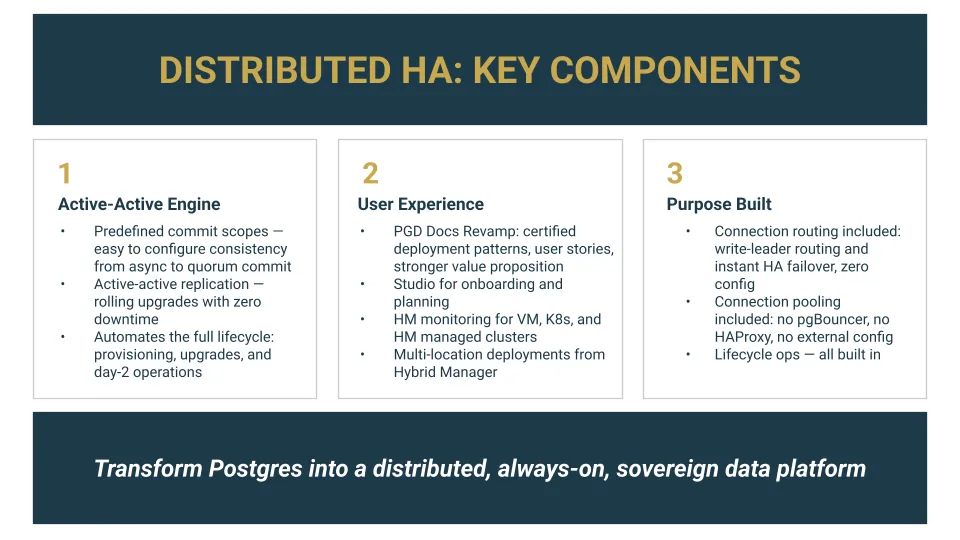
Distributed HA is EDB’s purpose-built solution for transforming Postgres into a distributed, always-on, sovereign data platform, without the complexity, the specialised skills, or the fragmented tooling that has made enterprise HA so difficult to operate.
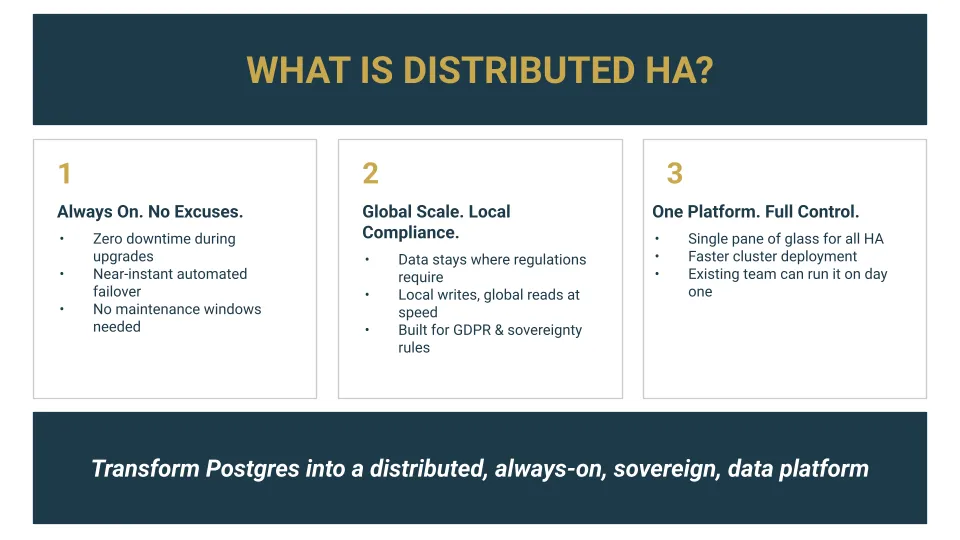
Distributed HA is built on three pillars:
1. Always On. No Excuses. Zero downtime during upgrades. Near-instant automated failover with no human intervention required. No maintenance windows, ever. The database runs, and it never stops. Rolling upgrades happen during business hours. Major version changes no longer require a weekend. Every node is active, meaning there’s no idle standby sitting in cold storage waiting to spin up, which also means every node is generating value for the infrastructure spend, not just waiting for disaster to strike.
2. Global Scale. Local Compliance. Data stays where regulations require it. Local writes and global reads at speed. GDPR and data sovereignty rules baked in at the architecture level, not bolted on as an afterthought. For enterprises expanding into new regions, or for organisations that can no longer use hyperscaler deployments due to sovereignty mandates, this is the architecture that makes global scale and local compliance coexist without compromise.
3. One Platform. Full Control. A single pane of glass across the entire HA environment, no stitching tools together, no tribal knowledge required, no specialist skills needed to operate it from day one. Cluster deployment is 75% faster than DIY approaches. And because the platform is built on native PostgreSQL, not a rewrite, not a compatibility layer, existing teams can run it immediately without retraining.
What’s New in Q2?
Distributed HA Studio - Q2 2026 release brings a guided planning experience that fundamentally changes how customers design and deploy high availability configurations. Rather than navigating complex technical decisions manually, customers can go design their high HA requirements by just answering simple questions; so now complex HA requirements are a thing of the past. In addition, we replace fragmented HA tools with a single platform that monitors, manages, and automates your entire global database estate. EDB Postgres AI unifies the full spectrum of high-availability options into a single control plane, so teams can simply deploy, manage, and scale resilient global services.
What previously consumed 100% of deployment time, it now takes 25% - Deployment is 75% faster than before. And critically, this removes the specialist skills barrier that has historically made enterprise HA feel inaccessible to teams without deep distributed systems expertise. Customers can now design, deploy, and validate their HA setup with the team they already have.
What This Looks Like in Practice
We’ve seen the three Distributed HA pillars (as discussed earlier) play out repeatedly across some of the world's most demanding data environments.
A global payment processor shared with us that every second of downtime is lost revenue at scale — and that standard HA capabilities simply couldn't meet their operational bar. Distributed HA's active-active architecture gave them the always-on environment they needed to stake their business on.
A major national bank expanding into millions of new users found that outages weren't just IT incidents — they triggered regulatory penalties, audits, and erosion of customer trust in a market where reputation is everything. Distributed HA eliminated the outages, simplified their deployment, and let them scale with confidence rather than adding infrastructure risk.
A global financial institution managing multi-regional continuous uptime told us their assembled stack of third-party tools was introducing failure points at every seam. One platform replaced the entire fragmented HA stack — and for the first time, they had a single interface for mission-critical Postgres, certified end-to-end and proven at global scale.
These aren't edge cases for organisations with unlimited budgets. When you hear the cost of downtime in these conversations, it becomes clear very quickly — this is a universal discussion.
The Business Value: What Changes for Your Organisation
For DBAs and SREs, the most immediate change is the end of the 3AM call. Near-instant automated failover with no human intervention means that when something happens at the infrastructure level, the system handles it and the team finds out in the morning, not in a war room. Rolling upgrades during business hours mean weekends are no longer sacrificed to maintenance windows. And with every node active, there’s no more anxious wait for a standby to come online during a critical incident.
For VP Infrastructure and Platform teams, the operational simplicity story is transformative. Managing three or more HA tools simultaneously, each with its own failure modes and integration risks, gets replaced with a single platform that is purpose-built, certified end-to-end, and operable by the team you already have. 75% faster cluster deployment changes how quickly new capability can be stood up. And because Distributed HA runs on-prem, in any cloud, or hybrid, it fits whatever the estate looks like today and wherever it’s going.
For CIOs, CTOs, and Economic Buyers, this is a board-level conversation. Downtime costs revenue, triggers SLA penalties, and creates regulatory exposure that affects the entire business. Distributed HA delivers 99.999% uptime on open-source Postgres, no Oracle lock-in, no proprietary stack, with an AI-ready, sovereign platform underneath that doesn’t block the modernisation agenda. It’s the infrastructure your business can grow on.
Ready to See It in Action?
Distributed HA is available now. Watch this guided Distributed HA Demo walkthrough of how to configure resilient, active-active Postgres for apps that can't go down. Stay online through failures, regions, and upgrades.
Tired of maintenance windows eating your weekends? Managing a fragmented HA stack that wasn’t designed to work together? Facing compliance requirements that your current architecture can’t meet? There’s a better way and it’s available today.
Your database should never go down. Transform Postgres® into a distributed, always-on platform. For businesses where downtime isn't an option, EDB Postgres AI (EDB PG AI) keeps your applications running globally through any condition. Talk to an expert today!